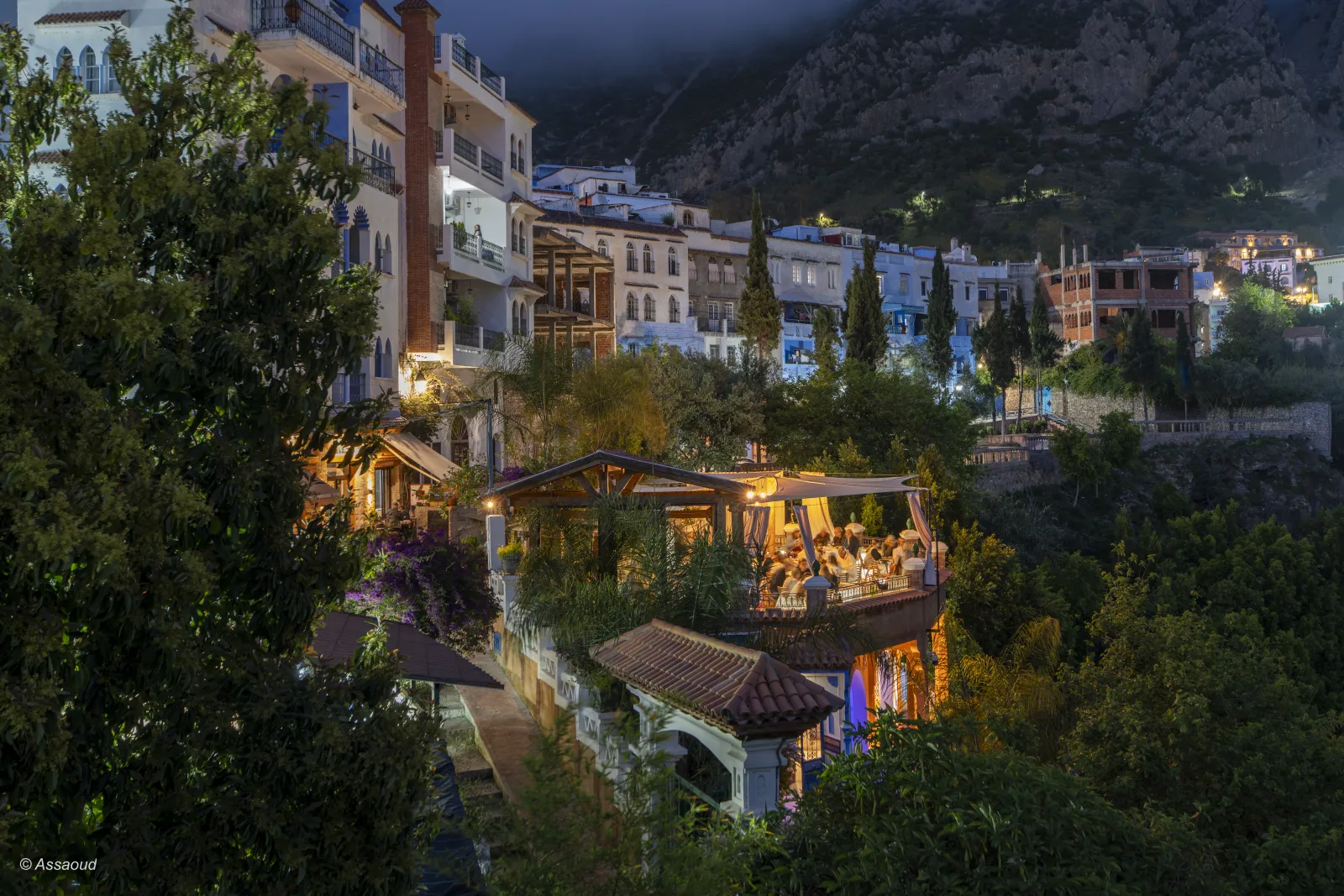
Chefchaouen: The Blue City and Its Secret Kitchen
Most visitors come for the blue walls. The ones who stay longer discover what the city is truly about: an extraordinary local cuisine born at the crossing of three traditions.
Most visitors come to Chefchaouen for the blue walls. They photograph the painted stairways, the cats asleep in sun-warmed doorways, the mountain light falling in oblique angles through the narrow medina passages. They often leave without discovering the city's most compelling secret: its extraordinary local cuisine.
A Mountain City, a Mountain Kitchen
Chefchaouen sits at 600 metres above sea level in the Rif mountains, where the Atlantic coast is close enough to shape the produce but far enough away to give the city its own distinct culinary identity. The result is a kitchen that draws from three deep traditions: Berber, Andalusian — the city was founded in part by Moorish and Jewish refugees from Granada in 1471 — and coastal Moroccan.
The Berber influence shows in the use of preserved and dried ingredients: sun-dried tomatoes, preserved lemons, dried mountain herbs, slow-cooked legumes. These are patient, understated dishes built around quality rather than quantity of spice. A Chefchaouen tagine is not the tourist-facing, heavily-spiced plate of the southern cities. It is quieter, more mineral, more honest.
The Andalusian Inheritance
In 1471, a group of Moorish and Jewish refugees from Andalusia founded Chefchaouen as a stronghold in the northern Rif. They brought with them seeds, recipes, and a sensibility about food that still echoes in the local kitchen: a preference for olive oil over argan oil, a love of aromatic herbs over heavy spice, a care for presentation that sits closer to the Mediterranean table than to the market stall.
The city's famous blue walls are themselves a legacy of this period — a tradition maintained by the Jewish community and continued across generations. The food carries its ancestry just as quietly and just as unmistakably.
What Grows Here
The Rif mountains produce ingredients unavailable anywhere else in Morocco: a wild fennel with a brighter, more herbaceous character than the farmed variety; a small, intensely sweet mountain tomato; goat cheese made within 30 kilometres of the medina; honey from bees feeding on thyme and wildflowers of the upper slopes.
These ingredients define a local terroir that deserves the same serious attention as any wine region. The altitude, the mineral-rich water, the cool nights and warm days — all of it registers on the plate, in the taste of a tomato, in the depth of a slow-cooked broth, in the fragrance of fresh-dried herbs.
triana Place in This Story
At Triana, we see ourselves as curators of this culinary inheritance — with one additional thread made explicit: the Andalusian connection. Our name, our philosophy, our menu are all rooted in the idea that the kitchens of Chefchaouen and Seville have always been speaking to each other across the water.
We are not a tourist restaurant. We are a restaurant for people who want to taste what Chefchaouen truly has to offer: a cuisine born at the crossing point of three civilisations, at altitude, in a city unlike any other in Morocco. Come with an appetite for something you have not tasted before.
Discover Chefchaouen through its cuisine
Book your table at Triana — the restaurant that brings Chefchaouen's culinary story to the plate. Browse the menu, the story, or the gallery.